

Is SEO dead? What Shopify Stores Must Know to Stay Visible on Google
Short answer: No. SEO is not dead for Shopify stores, but it has changed. AI Overviews now answer some research-stage searches on Google itself, so fewer of those clicks reach websites, while product, collection and purchase-intent searches still send shoppers to stores. Clean technical foundations, complete product data, intent-led content and brand authority keep a store visible in 2026.
The question "Is SEO dead?" has been asked consistently for nearly three decades, and the answer has remained the same: no, but it's constantly evolving. Each proclamation of SEO's death has actually marked the end of outdated practices and the beginning of more sophisticated, user-focused approaches.
So, here’s the truth: SEO as we knew it, is no more.
Because it has changed.
And in the world of E-commerce SEO, that shift is even more obvious.
Ranking on Google today isn't just about keywords or backlinks, it’s about showing up when your customer is searching, and making sure your product pages, content, and site experience are actually worth finding.
The pattern has proven itself over and over:
Those who adapt to changes in search tech keep getting found.
Those who don’t, drop off and call SEO a lost cause.
As long as people keep searching for products, answers, and reviews (which shows no signs of stopping), SEO will remain a crucial part of how E-commerce stores get discovered.
In this blog, we’ll explore what SEO has been, and what it’s becoming.
So let’s get started:
What happened to SEO? Why is being called dead?
As we mentioned at the beginning, “SEO is dead” is a phrase that keeps popping up in digital marketing circles. And now, with what many are calling The AI Revolution (2020-2025), that conversation has only gotten louder.
AI isn’t new. But the fear around it is.
When people started seeing AI platforms respond like humans, fast, accurate, and at scale, professionals across industries started wondering if they’d be replaced. Some actually were.
And SEO? It's one of the industries feeling the heat.
The final blow, or at least the most disruptive one so far, came from none other than Google.
Its rollout of AI Overviews has shaken up the search game more than anything since featured snippets. Why?
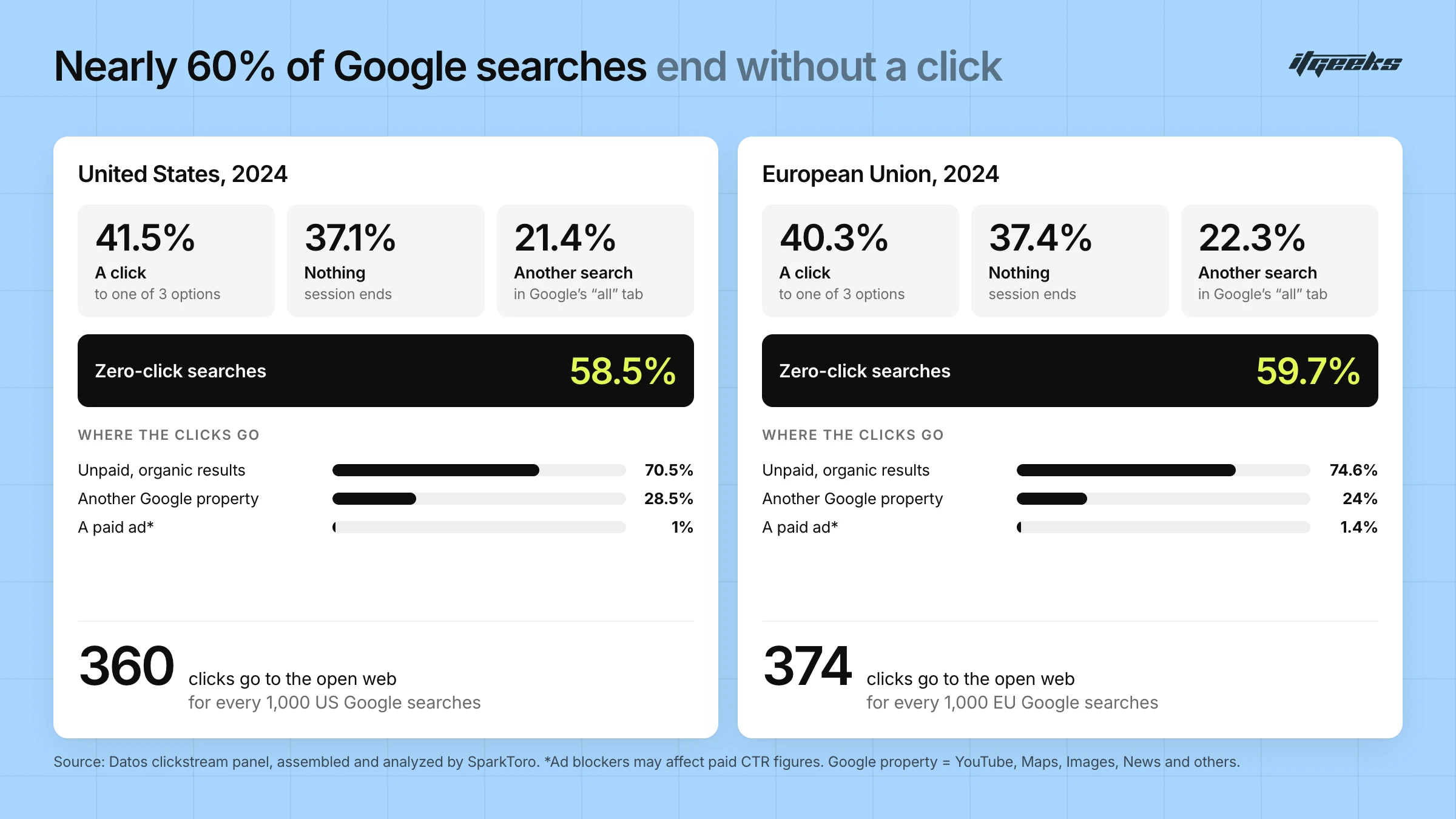
Because now, Google isn’t just pointing users to websites, it’s giving them direct answers, right there on the results page. As a result, nearly 60% of Google searches now end without a click, 58.5% in the United States and 59.7% in the European Union.
A note on that figure: it comes from SparkToro and Datos’ 2024 zero-click study, which analysed searches between September 2022 and May 2024. Zero-click searches were already common before AI Overviews, through featured snippets, knowledge panels and local results, so AI Overviews add to an existing trend rather than create it.
The SEO revolution vs Ecommerce SEO
Whether SEO is dead or not works a little differently for Shopify stores in 2025 (and all the ecommerce stores). The AI shift and Google’s new way of showing results (hello, AI Overviews) are shaking up how people find information online. But when it comes to E-commerce, especially product searches, the impact is a little different.
Here’s the thing:
People don’t just search for answers, they search to buy.
They look for product reviews, comparisons, how-tos, and category pages. And AI, at least for now, isn’t replacing that kind of search. It’s reshaping it.
Let’s take a look at what the AI Revolution (2020 to 2025) is bringing to SEO for Shopify stores.
As search engines evolve, especially with the rise of AI-generated answers, SEO is undergoing major changes.
But how do those changes impact Shopify stores specifically?
What’s changing in search
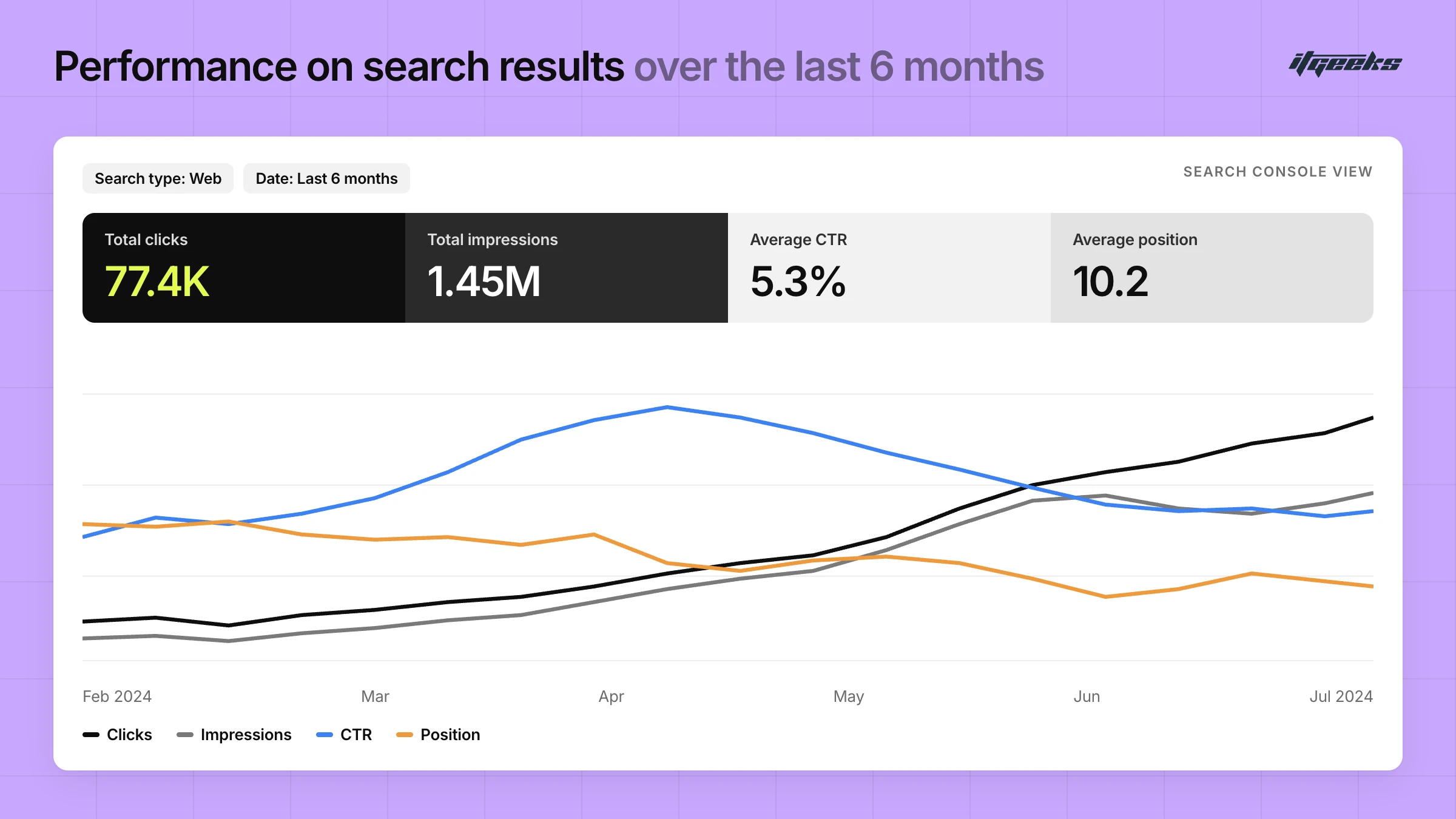
The biggest shift is the rise of AI Overviews on Google, summaries generated by AI that aim to answer search queries directly on the results page. This means:
Fewer clicks to websites, because users often get what they need without leaving Google.
Search results are being pushed lower, especially on mobile, where scrolling to organic listings now takes more effort.
More structured data being prioritized, meaning Google prefers content it can easily scan and understand.
These shifts affect all websites, but eCommerce stores, including those on Shopify, feel the impact differently.
Why Shopify SEO is more challenging than ever
Shopify stores rely heavily on product visibility in search. When someone searches for things like “best wireless headphones under $100” or “waterproof running shoes,” the goal is to show up with relevant product pages or collections.
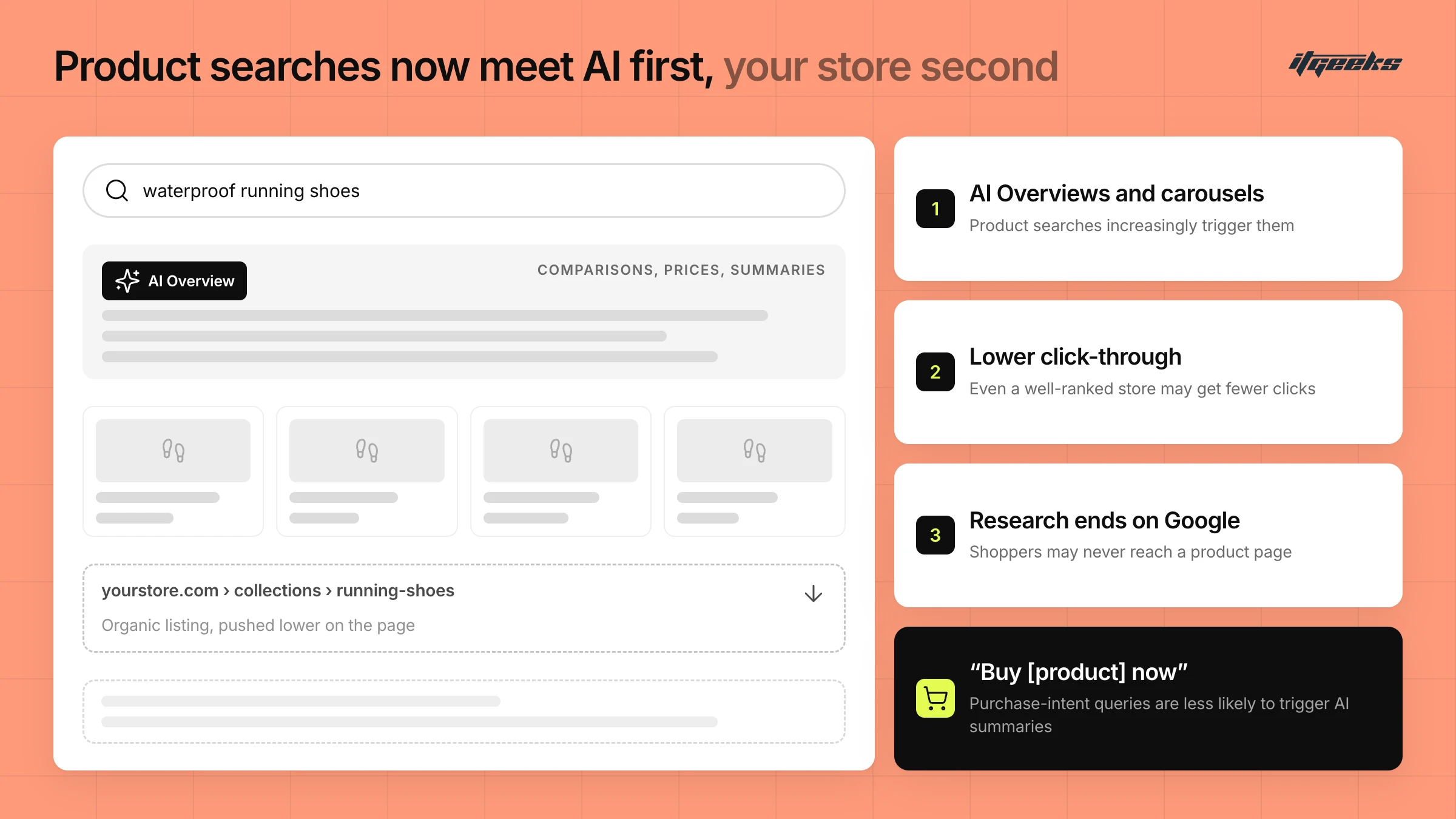
The challenge now is that:
These types of searches increasingly trigger AI Overviews or product carousels.
Even if a Shopify store ranks well, the click-through rate may drop, because Google is already displaying comparisons, prices, and summaries.
Shoppers may finish their research without ever clicking through to a product page, especially during the research phase.
At the same time, purchase-intent queries (like “buy [product] now”) are less likely to trigger AI summaries, meaning there’s still a strong opportunity for visibility closer to the point of sale.
So, how can Shopify stores adapt their SEO strategy?
Shopify SEO Strategies for 2025
Shopify SEO in 2025 is no longer about just stuffing keywords and waiting for traffic. It’s about a dual approach, adapting to how search engines are evolving while staying grounded in tried-and-tested fundamentals.
Let’s explore both:
1. New-Age SEO Practices (Built for the AI-Era)
These strategies focus on how modern search is changing with AI, voice, and entity-based search. They go beyond traditional ranking factors and prepare your Shopify store to thrive in an AI-first ecosystem.
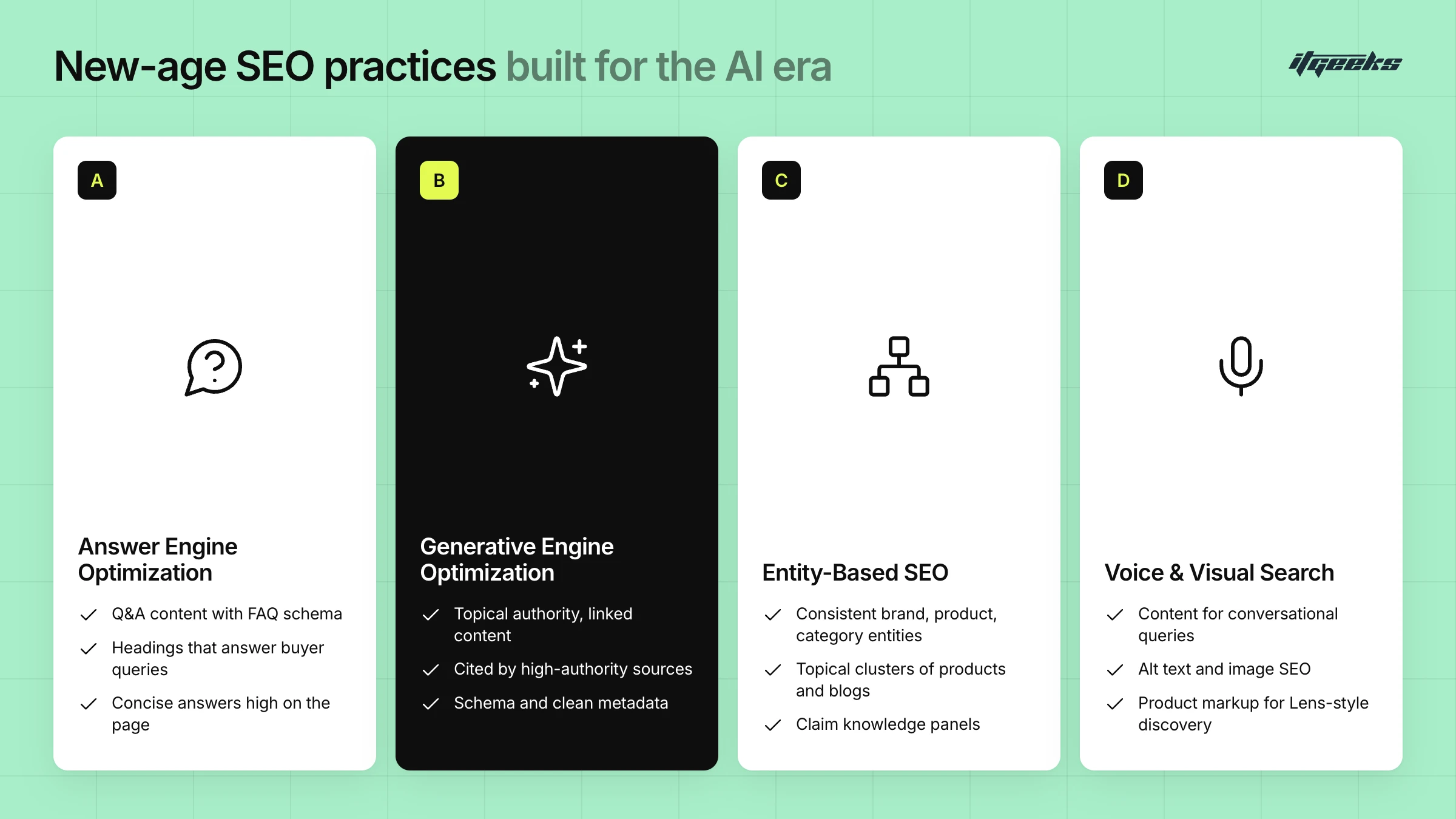
Answer Engine Optimization (AEO):
With Google’s AI Overviews and other answer engines (like Microsoft Copilot, formerly Bing Chat, or ChatGPT search), it’s no longer just about blue links.
Create Q&A-style content using FAQ schema.
Use headings and structured content that directly answer common buyer queries.
Optimize for featured snippets by offering concise answers high up on the page.
Keep expectations realistic. Google says there are no additional requirements or special optimizations needed to appear in AI Overviews or AI Mode, and no special schema.org markup to add. A page needs to be indexed and eligible to show with a snippet, and the usual SEO fundamentals still apply (Google Search Central: AI features and your website). FAQ markup is no longer a shortcut either: Google stopped showing FAQ rich results on 7 May 2026 (Search Engine Journal). Q&A-style content is still useful for shoppers and answer engines, and the markup is optional.
Generative Engine Optimization (GEO):
As tools like ChatGPT and Perplexity AI become content discovery channels, optimizing for generative platforms is key.
Build topical authority with interconnected, well-structured content.
Ensure your content is cited and referenced by high-authority sources.
Use schema markup and clean metadata: these engines pull from structured data.
Entity-Based SEO:
Google now understands topics via entities, not just keywords.
Use brand, product, and category entities consistently.
Link related products/blogs to build topical clusters.
Claim and enrich knowledge panels or structured listings where possible.
Voice & Visual Search Optimization:
Optimize content for conversational queries (e.g., “What are the best shoes under ₹2000?”)
Add alt text, image SEO, and product markup to cater to Google Lens-style discovery.
Evergreen SEO Strategies (Still Critical in 2025)
Some things don’t go out of style, they just get sharper. These are the SEO basics that still move the needle:
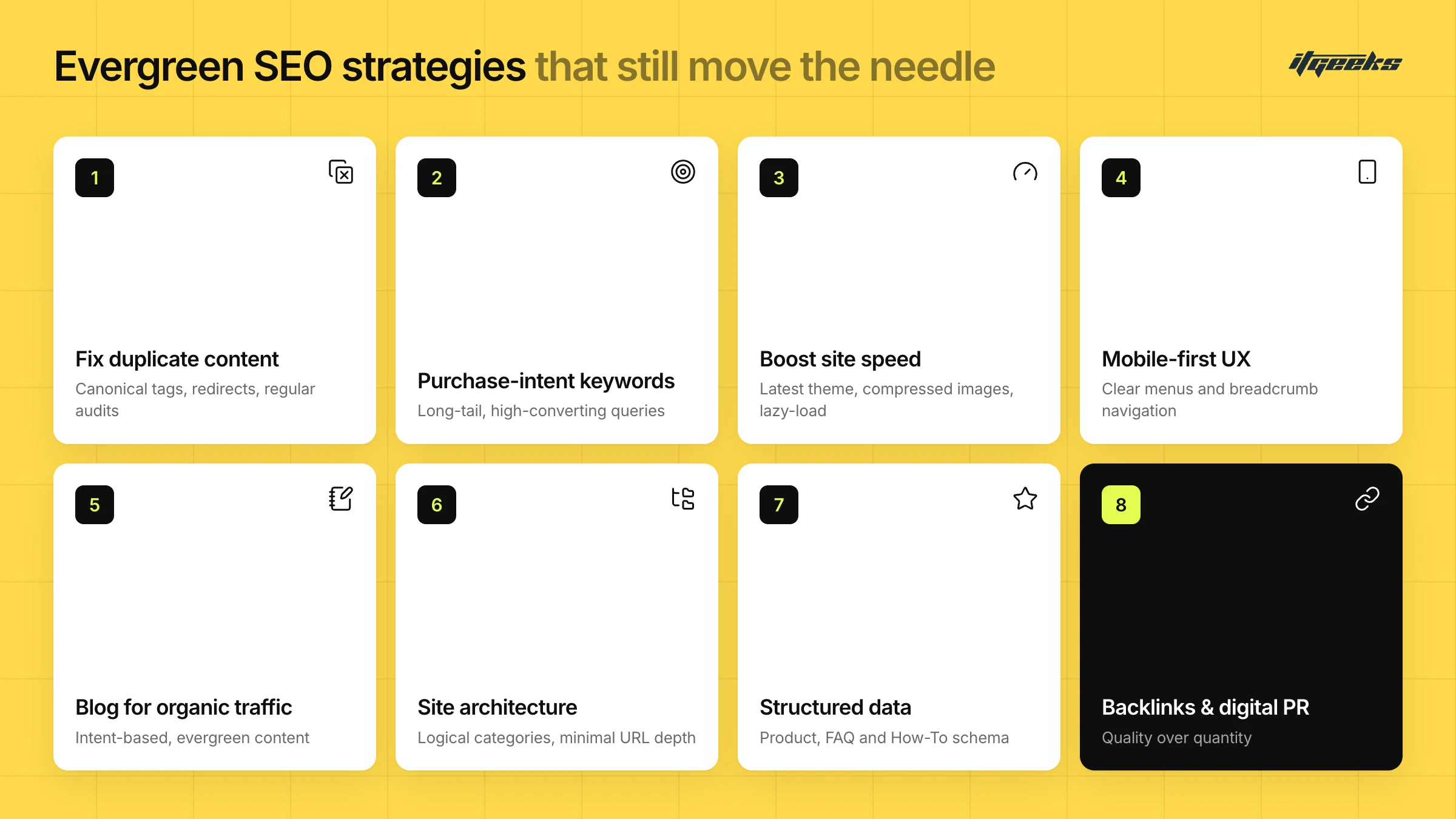
Fixing Shopify’s Duplicate Content Problem
Shopify’s URL structure can unintentionally create duplicate versions of product pages (e.g., /products/product-name & /collections/category/products/product-name).
These duplications are usually classified as innocent duplication, hence don’t directly result in penalisation by Google. But have a direct impact on your search engine rankings. There are some strategies, we have been employing as Shopify SEO experts for years, and they always works, are:
Implement canonical tags to consolidate authority to the preferred URL.
Use redirects where necessary.
Perform regular duplicate audits via Screaming Frog or Semrush to maintain content integrity.
Control crawl behavior with robots.txt rules for cleaner indexing. Google retired the Search Console URL Parameters tool in April 2022 (Search Engine Land), so parameter handling is now automatic.
Use the URL Inspection tool in Search Console to check which canonical URL Google selected for your key product pages.
Keyword Strategy That Aligns with Purchase Intent
A successful ecommerce digital marketing strategy is built on carefully selected keywords. For a Shopify store, you can’t base your SEO strategy on guessing. It is important to focus on high-converting, long-tail, and intent-driven search queries like:
“Affordable minimalist wallets with RFID”
“Best running shoes for knee pain”
“Organic baby lotion with lavender”
The best strategy to select keywords is analysing the competition, relevance, and search intent or buyer intent. Apply keywords naturally across product titles, meta data, descriptions, collection headers, and URLs.
Shopify SEO experts suggest using tools like Semrush, Ahrefs, and AI-powered keyword assistants to identify keyword clusters with buyer intent.
Boosting Site Speed for SEO and Conversion
A slow-loading Shopify store directly affects rankings and sales. According to Shopify, there can be various factors responsible for slow loading speed - outdated themes, unnecessary apps, extra third party code, and more. Metrics like Largest Contentful Paint (LCP), Interaction to Next Paint (INP), and Cumulative Layout Shift (CLS) impact the user experience, which in turn affects visibility in the search results.
Google’s “good” thresholds are an LCP of 2.5 seconds or less, an INP of 200 milliseconds or less and a CLS of 0.1 or less, measured at the 75th percentile of page loads (web.dev). INP replaced First Input Delay as a Core Web Vital in March 2024.
Our suggestion as an Ecommerce Digital Marketing agency is to update to the latest theme; preferably to a 2.0 theme, image optimization, compress text files, Minify CSS, JavaScript, and HTML, and Lazy-Load Images Below the Fold.
Designing for Mobile-First UX & Accessibility
Mobile devices (excluding tablets) account for over 60% of e-commerce traffic and more than 70% of online sales. The numbers itself signifies the importance of mobile-first UX and accessibility. Exact shares vary by source and year, so check your own analytics for your store’s mobile split. Shopify plus experts suggest choosing mobile-first Shopify themes like Ubone and Lusion, Clear menus, dropdowns, and breadcrumb navigation for smooth journey flow.
Pro tip: Consider having an Ecommerce Mobile Application for your ecommerce store for higher brand recallability and more conversions.
Read more about Ecommerce Mobile App.
Using the Shopify Blog to Capture Organic Traffic
Blogs aren’t an afterthought, they’re a discovery channel, and one of the easiest ways to improve SEO for a Shopify store. In our experience, the ecommerce stores that create intent-based, evergreen blog content ranks and converts better than stores without blogs.
Pro Tips:
Use keyword-rich titles, descriptions, and URLs
Use images and videos
Promote your content on social media
Optimizing Site Architecture for Scalability and Crawlability
A well-structured Shopify store ensures both users and bots can navigate effortlessly. When users can seamlessly navigate and find the products they tend to stay longer on the site and have high chances of making a purchase.
As Shopify Platinum Partner, we recommend:
Organize your product categories logically.
Use breadcrumb navigation. Breadcrumb navigation are also known as second navigation, These are clickable links at the top of a page. They show the path to the current page, like “Home > Men’s Clothing > T-Shirts.” Breadcrumb navigation makes your store much easier for people to navigate and for search engines to understand your website hierarchy.
Minimize URL depth
Implementing Structured Data for Rich Results
Rich results enhance SERP visibility with pricing, reviews, and availability, all without additional user clicks.
Inject product schema across product pages using Shopify themes or schema apps.
Include FAQ and How-To content where it helps shoppers, but note that Google no longer shows FAQ or How-To rich results and neither markup type increases AI Overview inclusion. Product markup (price, availability, reviews) is where structured data still pays off for stores (Google’s product structured data guide).
Stay updated with Google’s structured data guidelines (e.g., prioritize HTML over JavaScript for schema injection).
Building Authority Through Backlinks & Digital PR
Strong backlinks are still one of the top-ranking signals. For Shopify stores, this means quality over quantity.
Ecommerce is a highly competitive segment - if your product is unique there is no guarantee it will stay unique. But if you manage to acquire links from the right platform - there are high chances you will continue appearing first organically whenever customers are searching for you. While social bookmarking at random websites is the part of SEO which is actually dead now, Shopify SEO experts suggests following to attain high quality links:
Partner with influencers for product reviews with backlinks.
Guest Blogging
Collaborating with influencers
Digital PR
Internal linking
How AI shopping channels change Shopify SEO in 2026
Search is no longer only Google’s ten blue links. Shopify’s Agentic Storefronts let customers discover and buy your products in AI channels. Shopify’s help center lists ChatGPT, Google AI Mode and Gemini, Microsoft Copilot and Meta surfaces, and says products reach these channels through Shopify Catalog. It also says Agentic Storefronts are active by default for eligible stores, and you can manage the channels under Sales channels > Agentic (Shopify Help Center). Availability and checkout options differ by channel and store, so check your own admin.
For SEO, the practical takeaway is simple: the product data that search engines read is now also read by AI shopping tools. Complete titles, descriptions, attributes, variants, images and prices help in both places. If you want to go deeper, read our guide to ChatGPT’s in-chat shopping feature, our view on how AI is changing digital marketing, or how our team approaches AI and agentic commerce.
Where to start: a Shopify SEO checklist for 2026
Check indexing and canonicals. Use Search Console to confirm your key products and collections are indexed with the URL you intend.
Fix speed and interaction issues. Review LCP, INP and CLS, then remove unused apps and third-party code.
Complete your product and collection data. Fill every attribute, write unique descriptions and keep Product markup accurate.
Write for buying intent. Add helpful collection copy, comparisons and buying guides, and link them to the products they support. Our SEO-optimized Shopify redesign strategies guide shows how structure and SEO work together.
Earn mentions and links. Digital PR, reviews and credible partners build the authority both Google and AI tools look for.
Review your AI channels. See which AI channels are active for your store and whether your product data is ready.
Final Thoughts: Is SEO Dead for Shopify? Not Even Close
When done right - SEO is not even close to being dead. It’s the old practices like keywords stuffing, duplicated content, unstructured SEO practices that’s dying - leaving a mark on SEO. For Shopify Stores, the path to visibility has shifted from keyword-stuffing and generic link-building to experience-driven, intent-focused, and tech-savvy strategies. Google might not send traffic the way it used to, but it’s still rewarding stores that play by the new rules.
So, adapt your SEO to how people shop, not how they used to search.
And if your goal is to be found before your competitors, the time to rethink your Shopify SEO is now.
Frequently asked questions about SEO for Shopify stores
Is SEO still worth it for Shopify stores?
Yes. People still search for products, reviews and answers, and organic search is one of the few channels that keeps earning without paying per click. What has changed is the work: strong technical foundations, complete product data, intent-led content and brand authority matter more than keyword stuffing or generic link-building.
Do I need special schema or an llms.txt file to appear in AI Overviews?
No. Google says there are no additional requirements or special optimizations for AI Overviews and AI Mode, and that you do not need new machine-readable files, AI text files or markup. Pages must be indexed and eligible to show a snippet. Standard Product markup that matches the visible page is still worth having.
What should a Shopify store fix first for SEO?
Start with indexing and canonical URLs, then Core Web Vitals (especially INP and LCP), then product and collection content written for buying intent. Once those are sound, build authority through reviews, digital PR and useful content. This order protects the traffic you already have before you chase new channels.
ITGeeks: trusted Shopify SEO experts for hundreds of stores
At ITGeeks, we don’t just follow SEO trends, we stay ahead of them.
With experience since 2015 and hundreds of successful Shopify stores optimized across industries, our team understands what it takes to get your store found organically. Whether it’s adapting to Google’s AI-powered changes, fixing crawl issues, optimizing page performance, or helping you rank for high-intent keywords, we’ve done it all, and done it at scale.
Our SEO approach is tailored, data-driven, and rooted in Shopify’s ecosystem. As a Shopify Platinum Partner, we’ve worked closely with growth-stage and enterprise brands to create search-first experiences that convert. Whether you’re just getting started or looking to scale globally, ITGeeks is your partner in sustainable, search-driven growth.
If you want a second pair of eyes on your store, talk to our team or explore our Shopify marketing services.