


Let’s be honest - we all use ChatGPT for everything - it is sometimes our personal assistant, sometimes a listener, and sometimes a subject matter expert - no matter what the subject is.
People have also used ChatGPT as personal stylists. But, no one ever thought they would be able to shop via GPT, and that’s when OpenAI surprised everyone with rolling out a new feature - in chat shopping.
There is no doubt in saying this feature changed the way people pursue E-commerce. But what does OpenAI’s in-chat shopping feature mean for businesses?
The short answer: ChatGPT shopping launched on April 28, 2025 as a way to discover, compare and research products inside the chat, with links out to the merchant to buy. Since then, ChatGPT shopping has moved closer to Shopify: as of March 2026, Shopify’s Agentic Storefronts include ChatGPT, products are discovered in the chat, and the purchase is completed on the merchant’s own store checkout.
In this blog we will look at the feature in detail, what has changed since the launch (updated October 2026), and what E-commerce business owners can do to keep up with the trend.
So, what’s the fuss about:
OpenAI's recent launch of an in-chat shopping feature within ChatGPT
With rolling out a new feature - in-chat shopping feature within ChatGPT, OpenAI marked a significant evolution in AI-driven commerce, blending conversational AI with personalized product discovery. This update, rolled out globally on April 28, 2025, lets users search for products, compare prices, access reviews, and click direct purchase links-all starting from ChatGPT's interface. According to TechCrunch’s coverage of the launch, it was available to Plus, Pro, Free and logged-out users, and the first categories were fashion, beauty, home goods and electronics.
Let’s see it in reality:
As shown in the video shared by OpenAI at the time, shopping is as easy as chatting with a friend. Here's a quick example in the image below:
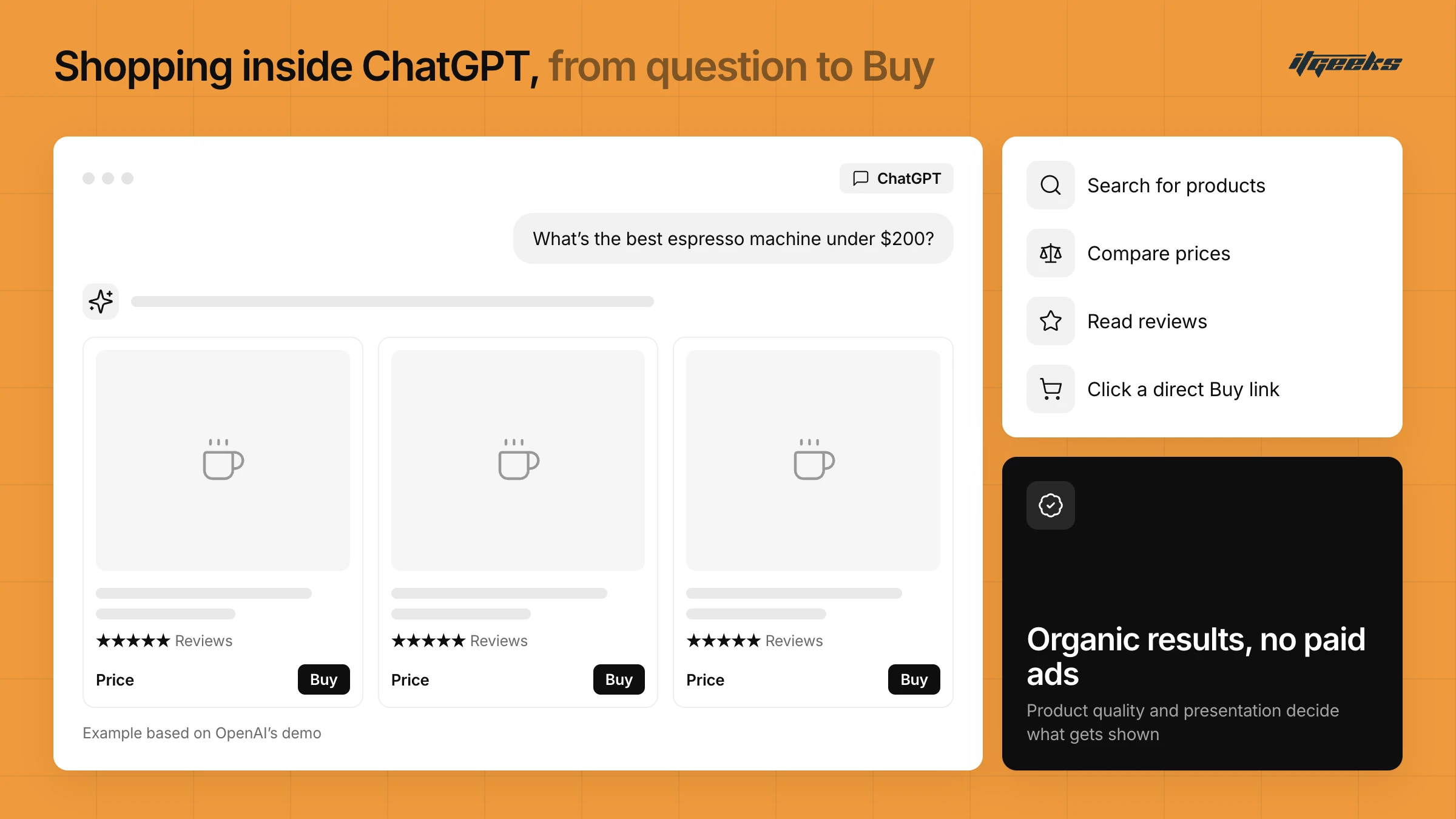
Yes, you simply ask for the product you're looking for, and ChatGPT will suggest options, each with images, pricing, reviews and a link to where you can buy it.
It’s worth mentioning that the products shown in the chat are organic, meaning no paid ads. OpenAI said it picks shopping results itself, based on structured data from third parties such as pricing, product descriptions and reviews, and it said it takes no commission on purchases made this way. So, there’s no shortcut to getting your product featured by AI. It all depends on how good your product is and how well your product data is presented. (More on this later in the blog.)
For users, this means no more endless product hunting, just quick, smart, and seamless research and purchases that start in ChatGPT.
But for businesses, the results might not be this straightforward. In the original launch, shoppers completed the purchase on the merchant’s website, so the merchant’s own product pages, data and checkout still did the heavy lifting. That raised the most important question of all:
Does OpenAI’s In-Chat Shopping Feature Hint at a Bigger Collaboration with Shopify?
Yes, and it has since become official. In April 2025, code discoveries hinted that OpenAI was testing Shopify’s checkout inside ChatGPT. In March 2026, Shopify launched Agentic Storefronts, which lets eligible Shopify merchants sell across AI channels, including ChatGPT, Microsoft Copilot, Google AI Mode and the Gemini app, managed from the Shopify admin.
Here is how the story unfolded:
April 2025, the code leak: A code leak suggested that OpenAI tested native shopping capabilities with Shopify. Neither company confirmed anything at the time. The leak included:
"shopify_checkout_url" parameter
"buy_now" functionality
Pricing and shipping fields
Product ratings integration
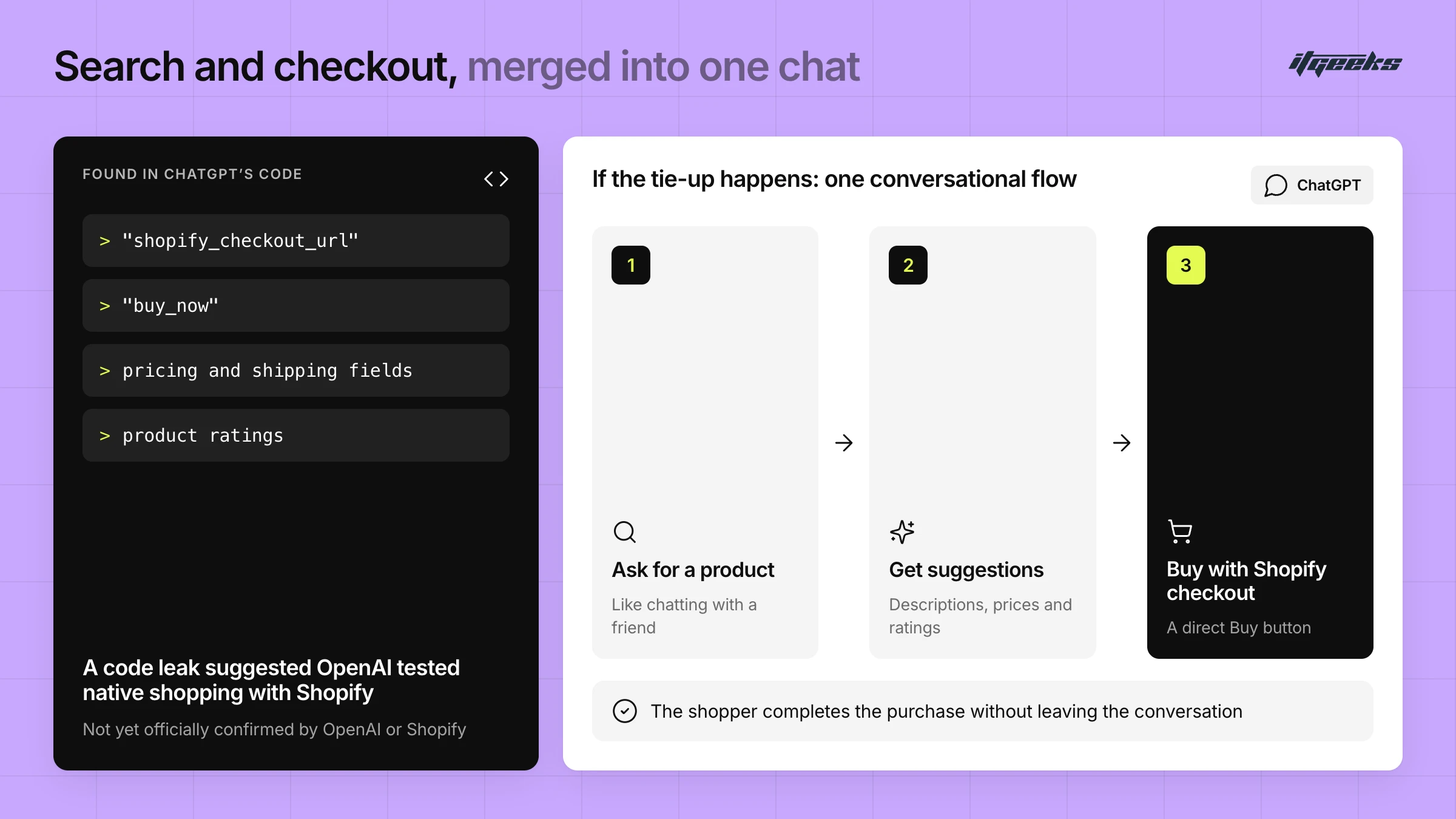
September 2025, Instant Checkout: OpenAI introduced Instant Checkout, built on the Agentic Commerce Protocol, and Shopify said merchants would sell inside ChatGPT conversations, as Digital Commerce 360 reported.
March 2026, the model changed: The plan shifted. Shopify now says buyers find products in ChatGPT through Shopify Catalog and complete the purchase on the merchant’s own store, in an in-app browser on mobile or a new browser tab on desktop. Shopify’s Help Center puts it plainly: ChatGPT users complete their purchase on your online store checkout.
Search and checkout have not collapsed into one in-chat flow for ChatGPT, then. What has happened is that discovery inside ChatGPT is now connected to Shopify’s catalog, and the sale still runs through the merchant’s own checkout and shows up in the Shopify admin. Shopify’s own page also notes that merchants remain the merchant of record and pay no transaction fees beyond standard processing rates (Shopify, March 24, 2026).
For merchants, the appeal is access to ChatGPT’s large user base and a shorter path from question to product page. Whether in-chat checkout returns for ChatGPT is something to watch, but the practical advice is the same either way: make your products easy for AI to find, understand and trust.
Coming back to our original point - the impact of this feature on businesses.
If you are an E-commerce merchant, you are already part of this game. And it means different things to businesses on Shopify and those who are not -
What ChatGPT’s in-chat feature Means For Shopify Merchants
Agentic Storefronts are active by default for eligible stores, and you manage which AI channels you sell on under Sales channels > Agentic in the Shopify admin. Shopify says ChatGPT is live for merchants in Shopify Catalog who sell to US buyers. Here is what that means in practice:
Expanded Reach and Visibility: Shopify merchants can appear in the product results of ChatGPT, a very large and diverse user base. This exposure can lead to increased traffic and potential sales by reaching customers who might not have discovered their products otherwise.
Seamless Conversational Commerce: Customers can discover products and get detailed recommendations in ChatGPT, then check out through your own store checkout, with your store’s customizations carried over. In Microsoft Copilot, Google AI Mode, the Gemini app and Meta, customers can buy without leaving the channel if direct checkout is switched on.
Operational Efficiency: Products reach AI channels through Shopify Catalog, so you list products once and keep prices and inventory current in the admin rather than managing separate feeds. Orders appear in your Shopify admin like any other sales channel, with the AI channel credited.
Personalized Marketing and Insights: Seeing which AI channels drive orders can help merchants understand how shoppers describe what they want, and tailor product offerings and marketing to user preferences. Shopify also lets you add a knowledge base with non-product information, such as return processes and shipping times, so AI agents can answer customer questions.
Competitive Advantage: Being part of this conversational commerce wave positions Shopify merchants at the forefront of retail innovation, enabling real-time engagement with customers during their decision-making process.
Eligibility and rollout details vary by channel and change often (Google and Gemini, for example, started with select US-based shops), so check Sales channels > Agentic in your own admin for the current status. Shopify’s Agentic Storefronts Help Center page is the reference to follow.
What ChatGPT’s in-chat feature Means For Businesses Not on Shopify
Increased Competition: Non-Shopify merchants may face challenges gaining visibility within ChatGPT’s shopping interface, because Shopify merchants are connected through Shopify Catalog by default. Shopify’s native catalog, checkout and product system integration can make Shopify-based stores more seamless and attractive to users.
Opportunity to Provide Product Feeds: OpenAI documents a structured product feed that merchants can share to appear in ChatGPT product results (see OpenAI’s commerce documentation), and brands that do not run their store on Shopify can list products in Shopify Catalog through Shopify’s Agentic plan, which Shopify says has no monthly fee, with standard payment rates per transaction. The process and benefits are less integrated than a native Shopify store, though.
Need to Adapt to AI-Driven Commerce: Businesses outside Shopify will likely need to optimize metadata and product information for AI crawlers like OpenAI’s OAI-SearchBot to ensure their products are discoverable in ChatGPT’s shopping results, similar to SEO for search engines.
Potential for New Sales Channels: Even without Shopify, businesses can benefit from the increased consumer reliance on AI chatbots for shopping research and product discovery, which could drive referral traffic and sales via direct links to their websites.
With every new feature in the market comes the need to embrace the change. But when it’s about businesses - embracing the change isn’t enough - you have strategies to stay ahead of the competition. And we have some suggestions for that.
Let’s move on to the next section of this blog -
What can businesses do to get their products recommended by ChatGPT?
Make product data accurate, complete and crawlable, and keep it consistent between your store, your feed and your structured data. Shopify names complete titles, descriptions, images, pricing, inventory and shipping speeds as the data AI agents read. Add conversational commerce tools and a clear strategy on top of that foundation. The six steps below cover both.
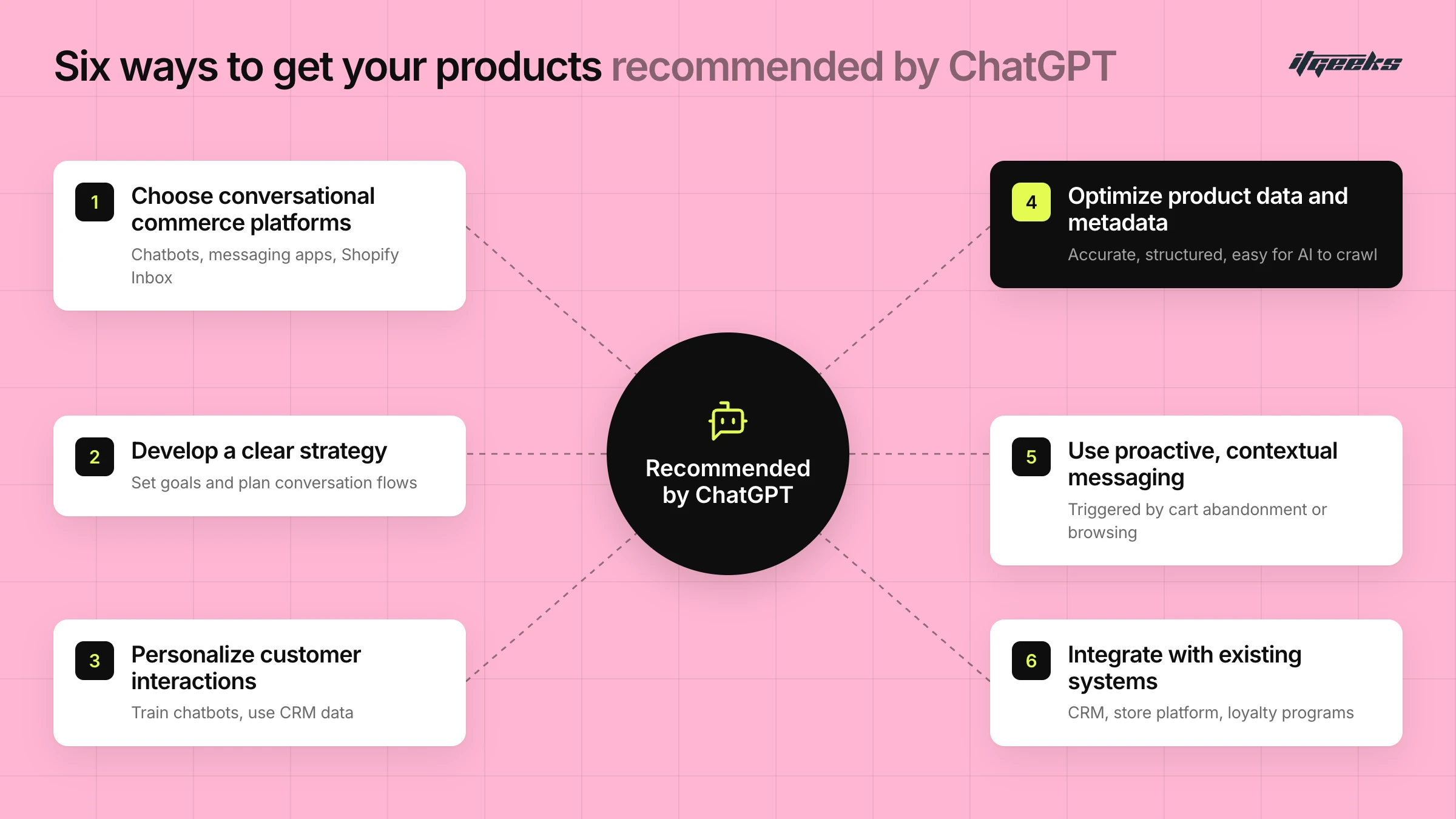
1. Choose Conversational Commerce Platforms
Choose and integrate conversational commerce tools such as chatbots, messaging apps, or chat apps from the Shopify App Store that allow direct interaction with customers during their shopping journey. You can migrate your store to Shopify with trusted partners, such as ITGeeks, a Shopify Platinum Partner trusted by Shopify to deliver high quality services.
Ensure these platforms support multiple channels (WhatsApp, Messenger, Instagram, etc.) to meet customers where they are.
2. Develop a Clear Conversational Commerce Strategy
Define the goals for conversational commerce (e.g., increasing sales, reducing cart abandonment, improving customer support).
Plan conversational flows that guide customers smoothly through awareness, consideration, purchase, and post-purchase stages.
Decide which inquiries chatbots will handle and when to escalate to human agents for a hybrid support model.
3. Personalize Customer Interactions
Leverage AI and machine learning to train chatbots with product information, FAQs, and customer preferences for more natural and helpful conversations.
Use customer data from CRM and other tools to create a 360-degree view, enabling personalized recommendations and proactive messaging.
4. Optimize Product Data and Metadata
Ensure product information is accurate, comprehensive, and structured to be easily crawled and understood by AI systems like OpenAI’s crawler. Complete titles, descriptions, images, pricing, inventory and shipping details are what AI agents read, so fill every field and keep it current.
Allow OpenAI’s search crawler. According to OpenAI’s crawler documentation, OAI-SearchBot is the agent used for ChatGPT search, and it is independent of GPTBot, which relates to model training. Blocking OAI-SearchBot in robots.txt can keep your pages out of ChatGPT search answers.
Add structured product data (schema.org Product markup) to product pages. Shopify’s guide to how agentic commerce works points merchants to a free audit tool that checks product-page structured data and robots.txt access for AI shopping assistants.
For non-Shopify merchants, explore ways to provide product feeds or metadata to appear in AI-driven shopping results, such as OpenAI’s product feed specification or Shopify’s Agentic plan.
5. Implement Proactive and Contextual Messaging
Use proactive messaging triggered by user behavior, such as cart abandonment or browsing patterns, to engage customers timely and reduce friction.
Incorporate click-to-chat links at multiple customer touchpoints to facilitate easy conversation initiation.
6. Integrate Conversational Commerce with Existing Systems
Ensure seamless integration with CRM, e-commerce platforms, loyalty programs, and customer data platforms to unify customer experience and data flow.
Other things to consider:
Test and Measure Performance
Before full deployment, rigorously test chatbot flows to ensure they answer questions accurately and provide a positive experience.
Track key metrics such as conversion rates, cart abandonment, customer satisfaction, and average response times to optimize continuously. If you sell on Shopify, review orders credited to each AI channel in your admin.
Prepare for Behavioral and Cultural Shifts
Educate teams and customers about the benefits and usage of conversational commerce to encourage adoption.
Address privacy concerns transparently, especially when using memory or personalized data in AI interactions.
Stay Updated and Innovate
Monitor emerging AI capabilities like image recognition and augmented reality that can further enhance conversational shopping, and watch how checkout in AI channels evolves, since the details have already changed once since 2025.
Explore partnerships and new channels to expand reach and improve the shopping experience continuously.
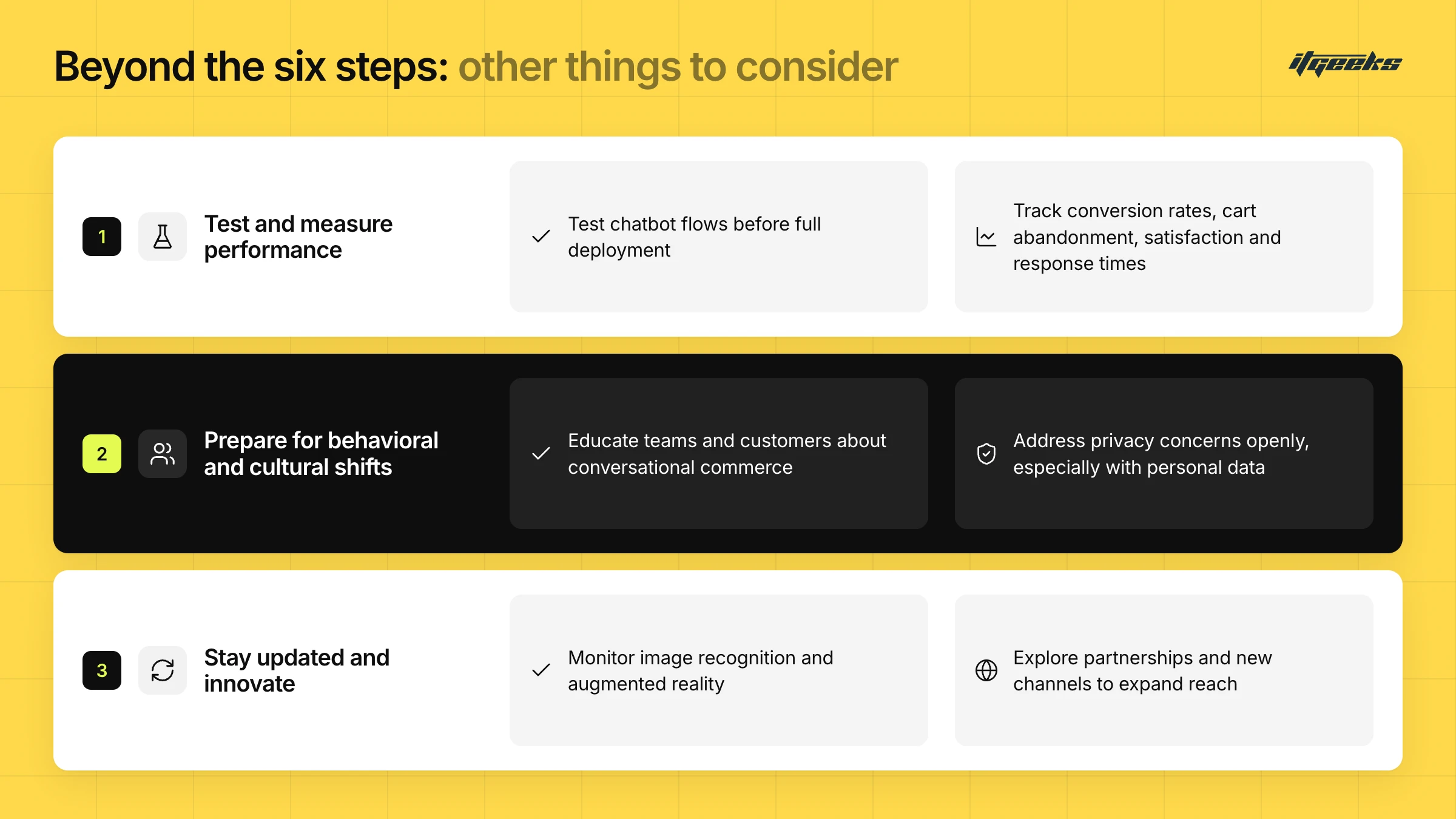
By following these steps, e-commerce businesses can position themselves to capitalize on the shift toward AI-powered conversational commerce, improving customer engagement, streamlining sales processes, and staying competitive in a rapidly evolving digital marketplace. More information here.
Related reading: how AI and machine learning are changing digital marketing and whether SEO is dead for Shopify stores. If you want help preparing your store for AI shopping channels, see our AI and agentic commerce services.
Our two cents -
The launch of in-chat shopping was more than just another feature update. It’s a clear signal that the future of commerce is conversational. With OpenAI entering the eCommerce scene, the lines between browsing, deciding, and buying are dissolving into a seamless, interactive experience, even if the exact point of checkout keeps shifting.
For businesses, this isn’t the time to sit back and observe. It’s the time to act, optimize, and align with platforms shaping the future of digital shopping.
And the best part? In eCommerce, you don’t have to do it alone.
We’ve got your back.
At ITGeeks, we help businesses stay ahead of every shift in the digital commerce landscape. With a strong foundation in Shopify and the trusted badge of a Shopify Platinum Partner, we’ve guided thousands of businesses through design, development, migration, and marketing; handling every challenge that comes our way.
Whether you're launching a new store, scaling an existing one, or navigating changes like AI-driven commerce, our in-house team of Shopify experts is here to help you turn disruption into opportunity. You can talk to our team about it.
Let’s build what’s next, together.